PORTCOAST at the Seminar on BIM and GIS Applications in Transport Infrastructure Management
On the morning of June 13, Portcoast attended the seminar “Application of BIM and GIS in Transport Infrastructure Management: Current Status and Solutions for Building Data Systems,” where experts discussed the role of digital data in managing and operating transport infrastructure. Representing Portcoast, MSc. Tran Phuc Minh Quang – Deputy General Director of Portcoast, shared practical insights on the roadmap for applying BIM, GIS, and Digital Twin technologies in Vietnam. He emphasized that digital transformation in infrastructure should begin with standardizing, digitizing, and connecting existing data, especially for assets that are already in operation. Portcoast remains committed to supporting the development of a modern, integrated, and sustainable data foundation for transport infrastructure.

Dr. Phan Hữu Duy Quốc - Member of the Scientific Council of Construction Magazine.
It is not yet possible to immediately achieve comprehensive Digital Twins models
Opening the discussion session at the seminar “Application of BIM and GIS in transport infrastructure management: Current situation and solutions for developing a data system” on the morning of June 13, Dr. Phan Hữu Duy Quốc - Member of the Scientific Council of Construction Magazine raised the question: technology enterprises have introduced many BIM, GIS and Digital Twin solutions, but what do management agencies truly need from these systems to support administration and decision-making?
In response to this question, MSc. Dương Đình Trung - Deputy Head of the Department of Science and Technology, Environment and International Cooperation, Vietnam Road Administration said that management agencies wish to use data for simulation, assessment and investment decision support.
According to MSc. Dương Đình Trung, to regulate traffic, connect road networks with urban railways, or assess the effectiveness of a road expansion project, management agencies need modeling and simulation tools. However, when studying Digital Twins models around the world, the Vietnam Road Administration found that this is a very large and highly complex challenge.
"Determining how far we should go to serve management needs is a very difficult question. For example, what scale of expansion for National Highway 1 would be effective, how metro lines should be connected, or what impacts would arise from investing in multiple projects at the same time are questions for which we still do not have adequate evaluation tools," MSc. Dương Đình Trung shared.

MSc. Trần Phúc Minh Quang - Deputy General Director of Portcoast.
From a consulting perspective, MSc. Trần Phúc Minh Quang - Deputy General Director of Portcoast said that many countries are now reaping the results of Digital Twins programs that were researched and invested in decades ago. Vietnam needs to realistically recognize that its current data conditions, resources and readiness level cannot immediately achieve comprehensive Digital Twins models as expected.
Further discussing the implementation roadmap, Dr. Tạ Ngọc Bình - Head of the Department of Investment Economics and Digital Construction Research, Institute of Construction Economics said that data remains the prerequisite. Even in BIM, many projects once aimed to integrate 3D models, schedules, costs and operations on a single platform. However, in actual implementation, schedule data was not updated regularly and input data was incomplete, causing the model to quickly lose its usefulness.
"If the data is not standardized, the more functions are integrated, the more likely errors will occur," Dr. Tạ Ngọc Bình noted.

Dr. Tạ Ngọc Bình - Head of the Department of Investment Economics and Digital Construction Research, Institute of Construction Economics.
According to Dr. Tạ Ngọc Bình, while researching the development of a national BIM platform, the Institute of Construction Economics encountered similar questions from specialized management agencies. What data does the Vietnam Road Administration need, what data does the Railway Authority need, and what information do appraisal agencies need to extract from BIM models?
International experience shows that before building digital platforms, countries must review their existing systems of standards and technical regulations, identify which data need to be extracted from BIM models, and convert them into machine-readable data requirements.
The challenge of digitizing existing structures
MSc. Trần Phúc Minh Quang said that many infrastructure works are still currently managed using paper records, PDF drawings, or documents that have been lost over many years of operation. To expand the use of BIM and GIS in operation and maintenance management, digitizing as-built data is a mandatory requirement.

MSc. Dương Đình Trung - Deputy Head of the Department of Science and Technology, Environment and International Cooperation, Vietnam Road Administration.
However, the representative of the Vietnam Road Administration offered a different perspective. According to MSc. Dương Đình Trung, for existing infrastructure systems, not every structure needs to be modeled at the detailed level of Digital Twins.
"The Vietnam Road Administration has digitized all assets along routes such as bridges, tunnels, signs and guardrails, with coordinates and current condition data attached to support management. However, building detailed 3D models for the entire system is not yet required by current management needs," MSc. Dương Đình Trung said.
According to MSc. Dương Đình Trung, for new roads, applying BIM from the beginning is necessary to support future operation. Meanwhile, for existing systems, the important point is to clearly identify management needs before deciding the level of investment in data digitization.
Agreeing with this view, Dr. Tạ Ngọc Bình said that re-digitizing all data of old structures would require very large resources. Even digitizing paper records is already a considerable workload, and if aerial surveys and large-scale 3D scanning are carried out, the costs would be much higher.
Under current conditions, priority should be given to standardizing data for new projects that are being implemented. Once enough data has been accumulated, advanced applications such as AI cameras, smart sensors or Digital Twins will have a foundation to become effective.
The gap between construction expertise and information technology
However, the issue that many delegates considered most concerning does not lie in technology or data, but in people.
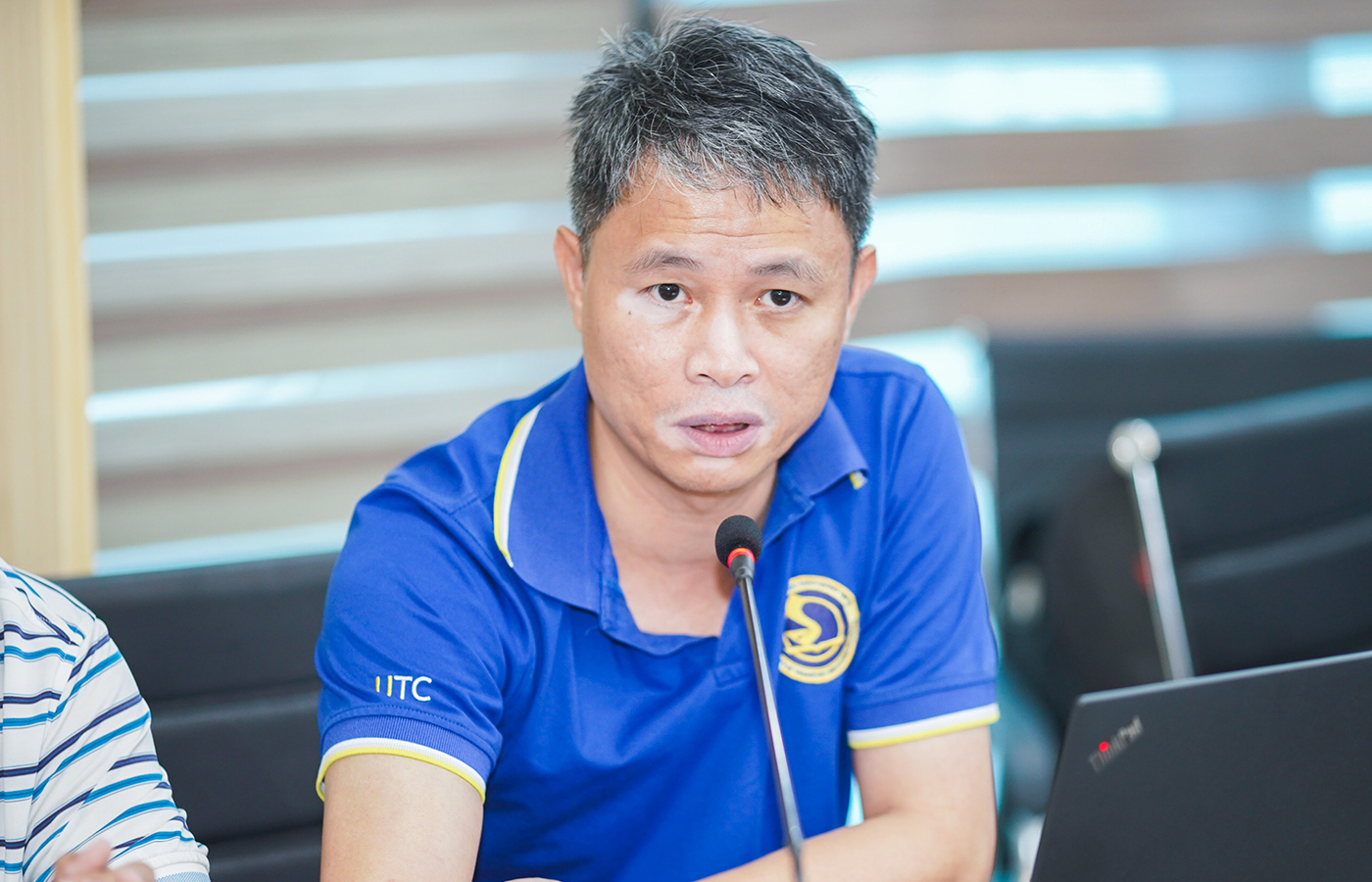
Dr. Nguyễn Văn Chính - University of Transport and Communications.
Assoc. Prof. Dr. Nguyễn Văn Chính - University of Transport and Communications said that in reality, there is currently a fairly large gap between construction expertise and information technology. Many transport engineers have strong professional expertise but limited digital technology skills, while information technology personnel lack specialized knowledge of the construction sector.
Even BIM is still often understood simply as a 3D model rather than a data management system spanning the entire lifecycle of a facility.
From the business perspective, MSc. Trần Văn Tâm - General Director of IDECO Vietnam Joint Stock Company said that the biggest difficulty today is the lack of consulting teams capable of implementing digital transformation in practice.
"Many universities only teach software use, but have not yet provided training in digital transformation. Enterprises have to spend from six months to one year training engineers before they can participate in real projects," MSc. Trần Văn Tâm said.

MSc. Trần Văn Tâm - General Director of IDECO Vietnam Joint Stock Company.
Meanwhile, MSc. Hoàng Minh Sơn - Head of the Technical Planning Department, BOT Bắc Giang - Lạng Sơn - Hữu Nghị Joint Stock Company said that the core of digital transformation is changing the way people think and work. With BIM, the way data is organized, how project stakeholders collaborate, and how facilities are managed all change compared with traditional methods.
According to MSc. Hoàng Minh Sơn, one of the current challenges is building a common data environment (CDE) to support project data management and sharing. Many organizations are using foreign platforms, but this raises issues related to data security, operating costs and the ability to master the technology.
Based on practical implementation experience, MSc. Hoàng Minh Sơn said that Vietnam needs to gradually develop CDE platforms created by domestic enterprises, meeting the requirements of construction project data management while ensuring security and reducing implementation costs for investors, consultants and contractors.
In addition, it is necessary to soon develop data standards, information exchange procedures and shared template systems for the entire sector. When data requirements are standardized from the outset, BIM implementation will be more convenient, limiting the situation in which each project or organization applies a different approach, thereby shortening implementation time and reducing costs throughout the entire project lifecycle.
At the close of the discussion session, one issue mentioned by many delegates was the coordination among management agencies, educational institutions and enterprises.
According to MSc. Dương Đình Trung, these are the three links that determine the success of the digital transformation process, but their connection remains limited. Government agencies need to define clearer requirements, universities need to become more deeply involved in human resource training, and enterprises must gradually master technology instead of merely using ready-made solutions.
The discussions at the seminar showed that BIM, GIS and Digital Twins are no longer purely technological issues. The biggest challenge today is correctly identifying management needs, building sufficiently good data, and preparing human resources with enough capability to operate the system in practice.
Source: tapchixaydung.vn
Pageviews: 0
PORTCOAST at the International Seminar on Advanced Railway Technology – ISART 2026
By www.utc.edu.vn - 12/06/2026
On June 12, 2026, Portcoast attended the International Seminar on Adva...
CHILDREN’S HOSPITAL 1 AND PORTCOAST SIGN A COMPREHENSIVE COOPERATION AGREEMENT
By nhidong.org.vn - 06/04/2026
On the morning of March 26, 2026, Children’s Hospital 1 and Portcoast ...
Portcoast Earns Global Recognition on Esri’s Official Channel
By thanhnien.vn - 09/03/2026
Vietnam’s digital construction capabilities have gained global recogni...